An Open Letter to YouTube: Why Can't We Get Straight Answers About Our Christian Children's Content?
After weeks of unexplained distribution problems, conflicting information from Google representatives, and hours spent with YouTube Creator Support, I'm publicly asking for transparency—not special treatment.
First, Let Me Introduce Myself
My name is Katrina McCaffery. I have worked in public relations and marketing for 24 years, and I've been creating and sharing content on YouTube since 2009.
Over the years, my channel has grown to more than 33,000 subscribers. I've experienced firsthand what happens when content connects with an audience. Some of my earlier videos have gone viral, attracted millions of views, and received attention beyond YouTube.
I'm not new to YouTube. I'm not new to marketing. And I'm certainly not new to understanding analytics, audience engagement, content promotion, or the importance of creating material that people actually want to watch.
My channel is also a member of the YouTube Partner Program.
But after nearly two decades on the platform, I've encountered a situation unlike anything I've experienced before. And despite numerous conversations with Google and YouTube representatives, I still cannot get a consistent, specific explanation for what is happening.
Introducing The Adventures of Moo Moo & Mooey
The Adventures of Moo Moo & Mooey is a family-created Christian children's entertainment project built around lovable cow characters, original music, colorful adventures, and positive educational messages.
Our goal is simple: create entertaining, engaging, family-friendly content that helps young children learn, laugh, sing, and grow.
Our songs introduce children to biblical stories, Christian values, prayer, kindness, and important life lessons through music and imaginative storytelling.
This isn't a project we threw together overnight. It represents countless hours of writing, recording, production, planning, and creative collaboration, along with a long-term vision to build something meaningful for children and families.
And the heart of that project is my own family.
How Our Music Is Really Made: The Human Creativity Behind Moo Moo & Mooey
Before anyone assumes The Adventures of Moo Moo & Mooey is simply a collection of AI-generated children's songs, I'd like to explain what actually goes into our productions.
I personally write our original songs, often with the help and inspiration of my two young daughters, Bella and Elena.
My girls aren't simply the inspiration behind the project. They participate in the creative process. Their ideas, personalities, and enthusiasm help shape the music we create for other children.
I also personally sing and record vocals for our songs. We record Bella and Elena's voices as well and incorporate their actual vocal recordings into our productions.
Those are real human voices, real family contributions, and original songs created by people who genuinely love what they're doing.
Yes, we use artificial intelligence as part of our production process. We're not hiding that, nor do we believe using modern creative tools diminishes the work we put into our music.
But there's an enormous difference between asking AI to create an entire project for you and using AI-assisted technology to help produce and bring your own original creative work to life.
Our music begins with us: our songwriting, our voices, our children's contributions, and our creative vision.
The Adventures of Moo Moo & Mooey isn't simply an AI project. It's a family-created children's entertainment brand that uses technology to help bring our original music, characters, and stories to life.
And we're proud of that.
Twenty-Six Videos Uploaded. Almost No Organic Distribution.
Over approximately five weeks, we uploaded 26 videos to our YouTube channel, @mooandmooey. Twenty-five of those videos were The Adventures of Moo Moo & Mooey content.
Most of our new children's music videos were designated Made for Kids.
What happened next was unlike anything I'd experienced during my many years on YouTube.
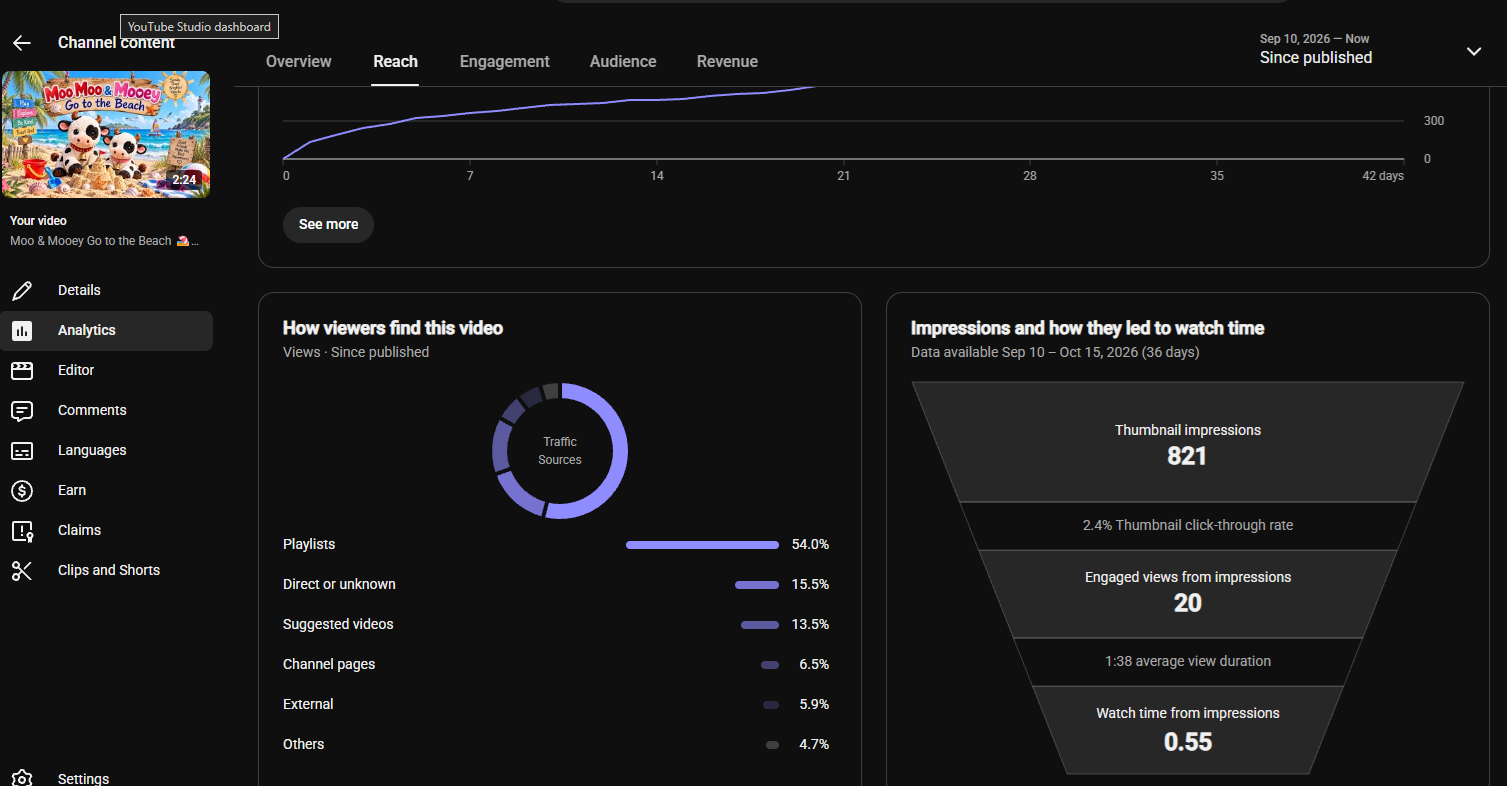
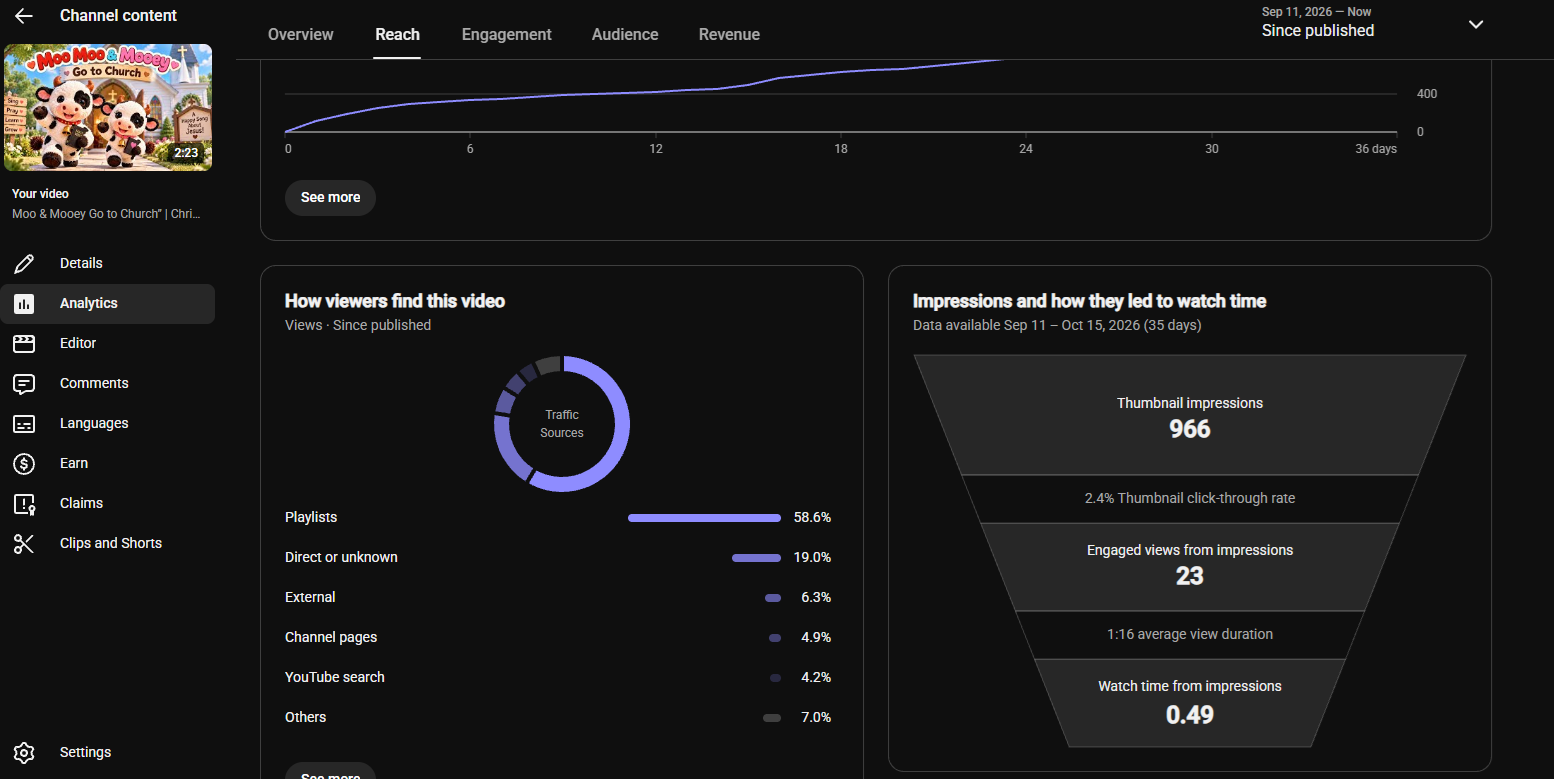
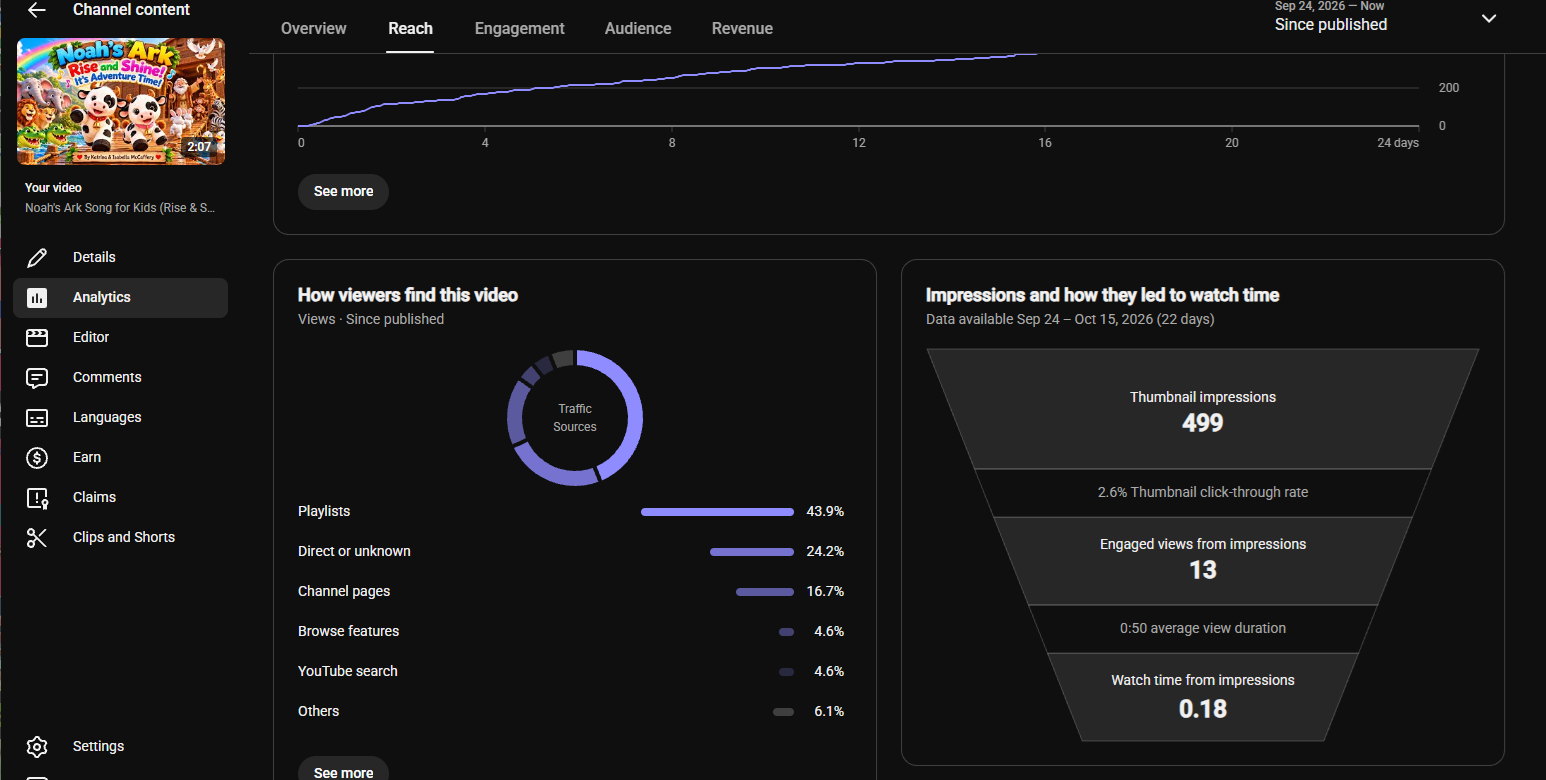
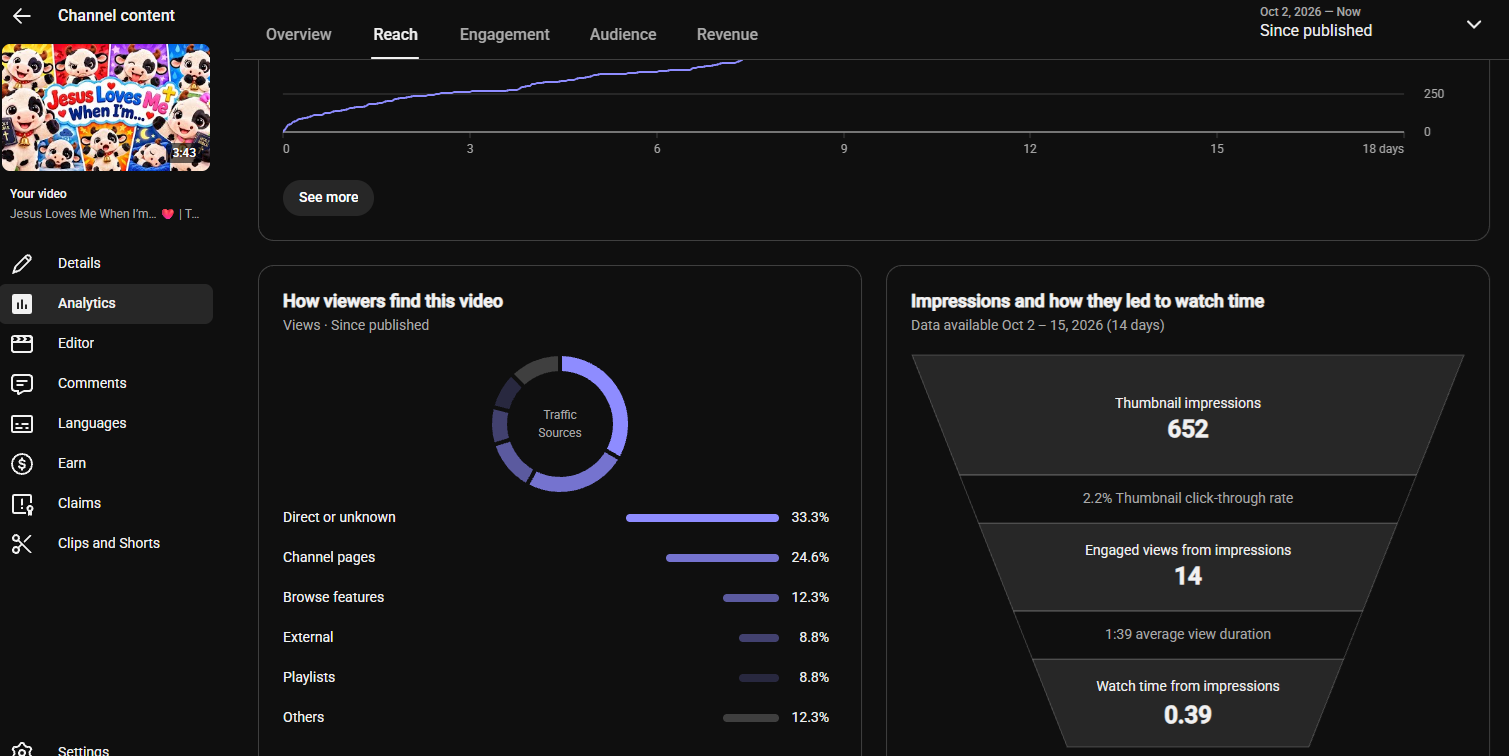
The overwhelming majority of our new videos received little to no meaningful recommendation traffic from YouTube itself.
Our views were largely coming from our own promotional efforts, external traffic, playlists, and people intentionally searching for our content.
We even organized a test involving more than 50 people searching for our videos by name and watching them.
We examined our analytics carefully. Several videos showed encouraging retention, click-through rates, and viewer engagement among the audiences they reached.
Yet the organic recommendations we were waiting for still weren't happening.
I understand that YouTube cannot guarantee views. I understand that every video performs differently, and that strong engagement among a limited audience does not guarantee broader success.
But how can audience interest be properly evaluated when a video has barely been introduced to an audience through the platform's recommendation systems?
That is the question we've repeatedly asked.
Examples From Our Video Analytics
The following screenshots show the individual-video Reach reports for four Moo Moo & Mooey uploads. They show thumbnail impressions and traffic sources as displayed in YouTube Studio through October 15, 2026. These are individual-video snapshots, not lifetime channel-wide totals.
We Even Paid YouTube to Promote Our Videos
Before anyone suggests that we simply need to invest in marketing, we already have.
We used YouTube's paid promotional tools for our first six videos.
Those campaigns generated encouraging performance statistics, but they did not lead to the organic recommendation activity we were trying to establish.
We've also invested considerable time and resources into titles, descriptions, keywords, thumbnails, audience research, and promotion.
Our team has studied successful channels in the children's entertainment industry and worked to optimize our content accordingly.
Yet during our October 16 support conversation, after repeatedly explaining that we had already promoted our videos ourselves, a YouTube representative included a link to information about promoting videos.
I recognize that this was part of a general list of support resources, not an explicit demand to purchase advertising.
Nevertheless, it was frustrating to receive another generic promotional resource after explaining that paid promotion hadn't resolved our concern.
Then Something Unexpected Happened
One of our Christian children's songs, "Amen! Praise the Lord!", initially experienced the same lack of recommendations as our other uploads.
During an earlier interaction with Google support, we were told that a hold affecting the video had been lifted. We were also given explanations involving a manual intervention and an ongoing process of testing or distributing our newer content.
Following that interaction, "Amen! Praise the Lord!" began receiving meaningful YouTube recommendations and performed extremely well compared with our other new uploads.
That experience raised an obvious question.
If nothing was preventing our videos from being recommended, what exactly had been lifted?
And why did the change coincide with such a dramatic difference in distribution?
We have repeatedly asked YouTube to explain this.
We have not received a satisfactory answer.
I'm not claiming to know what happened behind the scenes, or that the timing alone proves a manual change caused the increased distribution. I'm asking YouTube to clarify what its own representatives meant and what action, if any, was actually taken.
What About YouTube Kids?
This is perhaps one of the most troubling unanswered questions of all.
Our content is specifically created for children. Yet despite extensive searching, our team has been unable to find our new content in the YouTube Kids app.
We understand that labeling a video Made for Kids does not automatically guarantee inclusion in the separate YouTube Kids app.
That is precisely why we asked for clarification.
Previous Google representatives gave us estimates suggesting that children's content could take approximately 30–45 days to begin receiving recommendations or around 60 days to appear in YouTube Kids. We were also given explanations involving review periods and trust thresholds.
Other representatives subsequently contradicted those explanations.
We also discovered discussions from other children's content creators who reported that YouTube support had submitted their channels for YouTube Kids review after they requested assistance. Those accounts were anecdotal, but they gave us a reasonable basis to ask whether such a review process was available.
So we asked YouTube directly:
Has our channel been evaluated for YouTube Kids? Are our videos eligible? Can our channel be submitted for review? If not, why not?
Despite raising these questions during our support interactions, we still have not received a direct answer.
A simple explanation that the review process is unavailable, that we haven't met specific requirements, or that our content is still awaiting evaluation would have been helpful.
Instead, the questions remain unanswered.
Are Christian Children's Creators Being Treated Differently?
This is a question I never expected to find myself asking.
My team and I have spent considerable time searching YouTube Kids for Christian children's music and entertainment. Based on our searches, we've found relatively limited representation compared with the broader range of children's entertainment available.
Listener Kids is among the most prominent Christian children's music brands we've encountered.
We recognize that our searches alone cannot establish the full composition of the YouTube Kids catalog or prove that any category of content is being treated differently.
But combined with our own experiences and the conflicting explanations we've received, the limited selection we've encountered has raised questions we believe deserve serious consideration.
Is this simply a broader issue with new Made for Kids content?
Is there an unexplained technical or eligibility problem affecting our channel?
Or could Christian children's content be encountering barriers that other types of content do not?
We are not claiming to have proven religious discrimination. We are asking whether it is occurring and requesting enough transparency to understand what is happening.
Another Unanswered Question: Why Was My Verification Badge Removed?
In 2019, YouTube changed its verification requirements from 10,000 subscribers to 100,000 subscribers.
At that time, existing verified creators, including myself, received emails from YouTube informing us that our verification badges would not be removed simply because of the new subscriber requirement.
This wasn't an assumption on my part. It was something YouTube communicated directly to us.
My channel retained its verification badge following the announcement.
However, at some point after February 12, 2021—the date of an archived capture showing my badge—it disappeared without an explanation. I have not established the exact removal date.
During that period, I was primarily uploading Christian content, including clips of my pastor's sermons and recordings of my mother singing gospel music at church.
I had not changed my channel name when the verification badge disappeared, nor had I received any notification of a policy violation or explanation for its removal.
In September 2026, after my verification badge had already disappeared, I rebranded my channel from @kittymccaffery to @mooandmooey to reflect the launch of The Adventures of Moo Moo & Mooey.
My recent channel name change could not have caused the removal of a verification badge that had disappeared before the rebranding.
Why did my badge disappear after YouTube assured existing verified creators that they would retain theirs?
Was there another eligibility issue? Was it an administrative decision? Or was something else involved?
I cannot say whether the religious nature of my uploads at the time had anything to do with what happened.
But given the current situation, I believe the unexplained badge removal deserves an answer as well.
After raising this issue during my October 16 support conversation, I was told it would be referred to a dedicated team for investigation.
October 15: A Support Representative Confirms Everything Is Working—Then Contradicts Earlier Explanations
On October 15, 2026, I contacted YouTube Creator Support and spoke with a representative named Beatrice.
My request was specific: investigate whether an indexing, eligibility, or technical distribution issue was affecting my channel.
By this point, the problem had expanded beyond our Made for Kids music videos. Even recent family Shorts that were not designated Made for Kids were experiencing unusually limited Shorts feed distribution compared with previous uploads.
Beatrice initially assured me:
"I will check the status of your channel's indexing and recommendation systems."
Later, she stated:
"I can confirm there are no technical or account-level issues."
And then:
"I have verified that your channel and recent uploads are fully indexed and eligible to appear in recommendations."
She also informed me that the issue could not be escalated because everything was working as intended.
This conflicted with explanations previously provided by Google representatives, who had described an ongoing indexing or onboarding process, a staged testing period, and an intervention involving our song "Amen! Praise the Lord!"
When I asked Beatrice to reconcile those explanations, she stated:
"YouTube's recommendation system does not use a manual testing queue or a 'trust score' mechanism."
Yet only minutes later, she explained:
"When a video is first published, the system tests it with a small, highly targeted audience to gauge initial response."
I recognize that automated audience testing is not necessarily the same thing as a manual testing queue. But that distinction was never clearly explained in relation to what previous representatives had told us about our particular channel.
I also asked how YouTube could evaluate audience interest when our analytics showed that most of our new videos had received little to no recommendation exposure.
Instead of providing the requested video-specific findings, the conversation repeatedly returned to general explanations about thumbnails, metadata, impressions, and viewer engagement.
At one point, Beatrice offered this explanation:
"The decrease in impressions might have been caused by an influx of interest from your audience on the platform."
I asked what specific audience data supported that statement. No such data was provided.
Then, unexpectedly, Beatrice informed me that claimed content had been found in "Amen! Praise the Lord!"
I explained that I am the original songwriter and vocalist and had distributed my own music through DistroKid. I asked whether the claim was associated with my own recording, whether it affected recommendation eligibility, and how it related to the other videos experiencing distribution problems.
Those questions were not directly resolved.
Perhaps most frustratingly, Beatrice repeatedly assured me that she was investigating the specific statistics of my uploads, but ultimately concluded:
"However, this is the only resolution I can provide."
After approximately 40 minutes, I ended the conversation without an explanation for the discrepancies between representatives, without the requested individual-video findings, and without a technical escalation.
YouTube Support Case: 4-6088000041789 — October 15, 2026
October 16: Ninety-One More Minutes With YouTube Support—and Still No Answers
The following day, October 16, I contacted YouTube support again.
This time, I spent approximately 91 minutes speaking with support representatives, including a supervisor.
I supplied my channel information, described the distribution problem, explained the difference between my older viral videos and our new children's songs, and repeatedly asked for a video-specific investigation.
Instead, I was presented with general information about how YouTube recommendations work.
The supervisor cited channel-wide traffic percentages and aggregate analytics as evidence that my channel was receiving recommendations.
But my complaint was never that my entire channel had stopped receiving views.
My complaint concerned the new uploads.
My older viral videos continue attracting viewers. Their performance does not answer why our newer Christian children's content is receiving so little organic distribution.
Despite my repeated explanations, the conversation returned to familiar advice about thumbnails, titles, audience interest, and normal fluctuations.
I have worked in marketing for more than two decades. I understand these concepts.
What I don't understand is why the individual videos at the center of my complaint were never meaningfully addressed in the representatives' explanations.
I also specifically asked about YouTube Kids inclusion and whether my channel could be submitted for review.
Those questions were not answered.
The conversation ended without a clear explanation for the distribution of our newer videos or their YouTube Kids status.
YouTube Support Case: 5-0019000041466 — October 16, 2026
What We Are Asking YouTube to Do
We are not asking for preferential treatment.
We are not demanding guaranteed views, guaranteed recommendations, or automatic inclusion in YouTube Kids.
We are asking for an honest, specific investigation.
We respectfully request that YouTube:
- Review the individual analytics and recommendation eligibility of our affected new uploads, rather than relying solely on channel-wide statistics.
- Clarify whether any review, eligibility limitation, distribution restriction, or other account-specific issue is affecting these videos, including our general-audience Shorts.
- Explain the earlier representative's statement that a hold was lifted from "Amen! Praise the Lord!" and clarify whether any manual intervention occurred.
- Confirm whether our channel and videos have been evaluated for YouTube Kids and whether a review can be requested.
- Clarify the conflicting information provided about waiting periods, indexing, staged testing, and trust requirements.
- Explain whether the copyright claim identified on "Amen! Praise the Lord!" is associated with my own DistroKid distribution and whether it affects recommendation eligibility.
- Investigate the disappearance of my previously displayed verification badge after February 12, 2021, and reconcile the archived evidence with YouTube’s historical records.
- Respond to these concerns in writing with findings specific to our channel.
We are publishing this letter to give YouTube an opportunity to address these questions transparently.
To Other Creators Experiencing Similar Problems
If you're a children's content creator—Christian or otherwise—and you've experienced unexplained delays, missing recommendations, difficulty appearing in YouTube Kids, or conflicting answers from support, I would genuinely like to hear your experience.
Have you encountered similar problems? Were you able to request a YouTube Kids review? Did you eventually receive an explanation?
The more we understand about what creators are experiencing, the better we can determine whether these are isolated problems or part of something broader.
A Final Word to YouTube
After nearly 20 years on your platform, I never imagined I'd be writing this letter.
I believe creators deserve to understand the rules and processes that affect their work, even when those processes cannot guarantee success.
My family and our creative team have invested our time, resources, and hearts into The Adventures of Moo Moo & Mooey.
We want the same opportunity as other creators to have our work discovered and evaluated by an audience.
We aren't asking YouTube to make our videos successful. We're asking YouTube to answer our questions.
And after weeks of trying, we believe that is a reasonable request.
UPDATE · October 20, 2026
New YouTube Support Emails: Historical Verification Disputed, Distribution Questions Still Unanswered
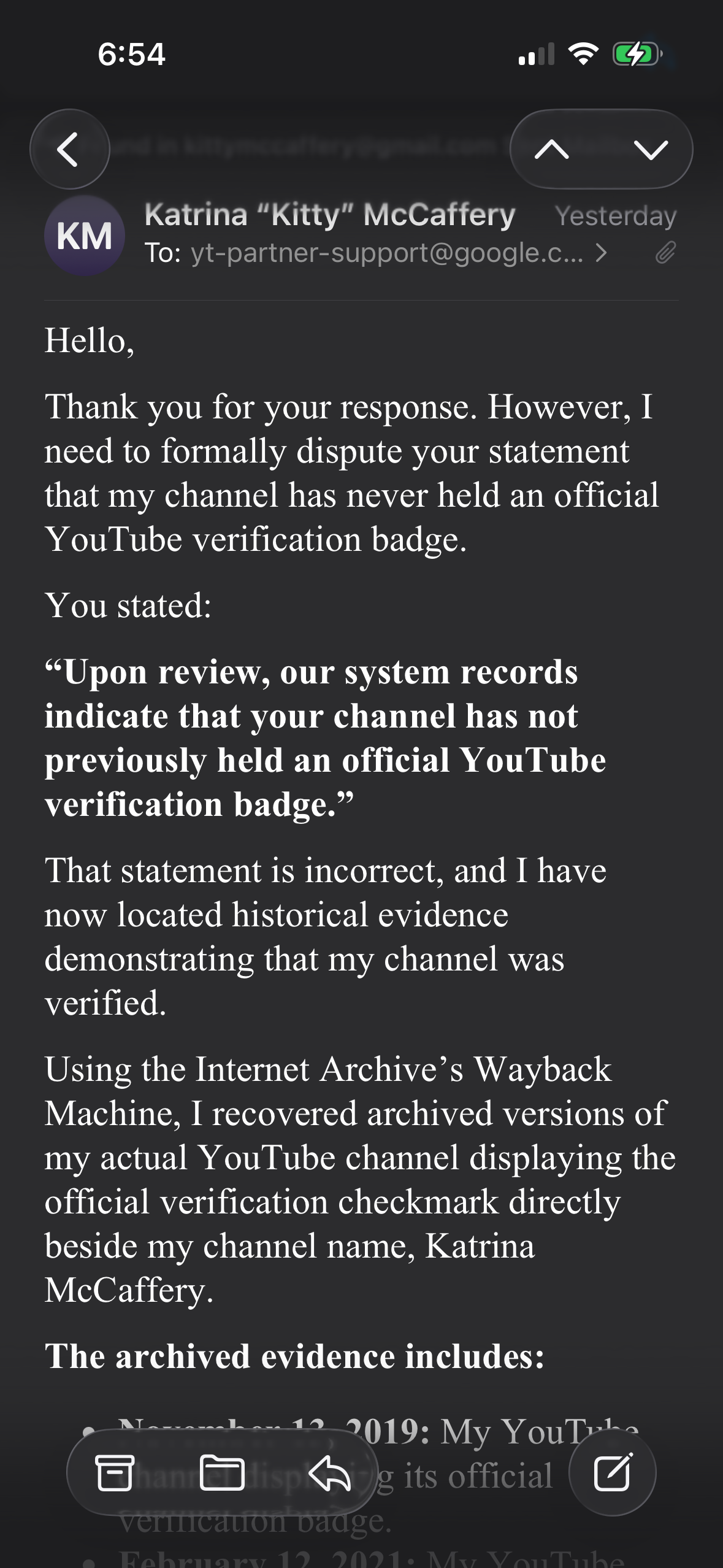
Since publishing this open letter, I have continued corresponding with YouTube Creator Support. The latest email exchange has raised an additional concern: a support representative told me that YouTube’s records indicate my channel had never held an official verification badge, even though I subsequently located archived versions of my channel displaying that badge.
October 18–19: An Answer to a Question I Wasn't Asking
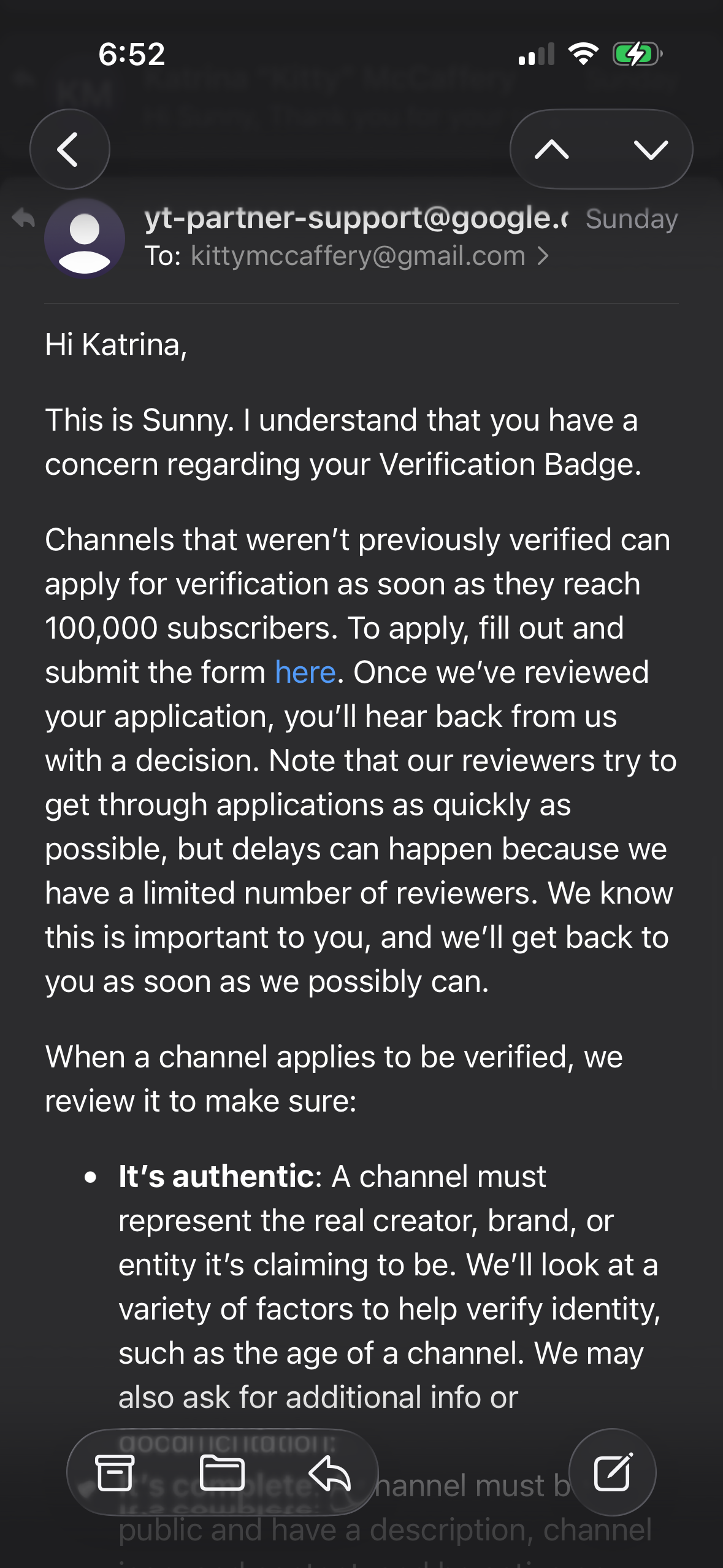
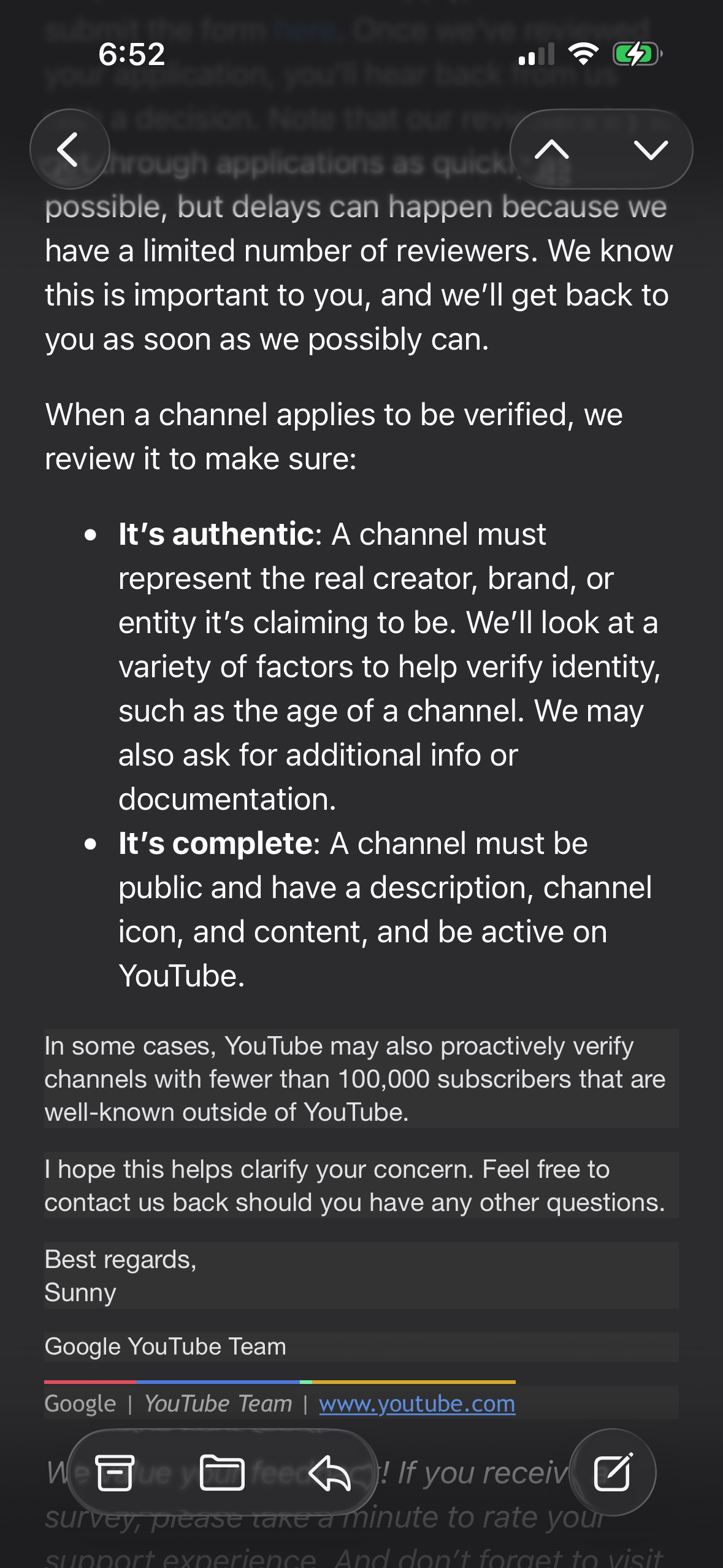
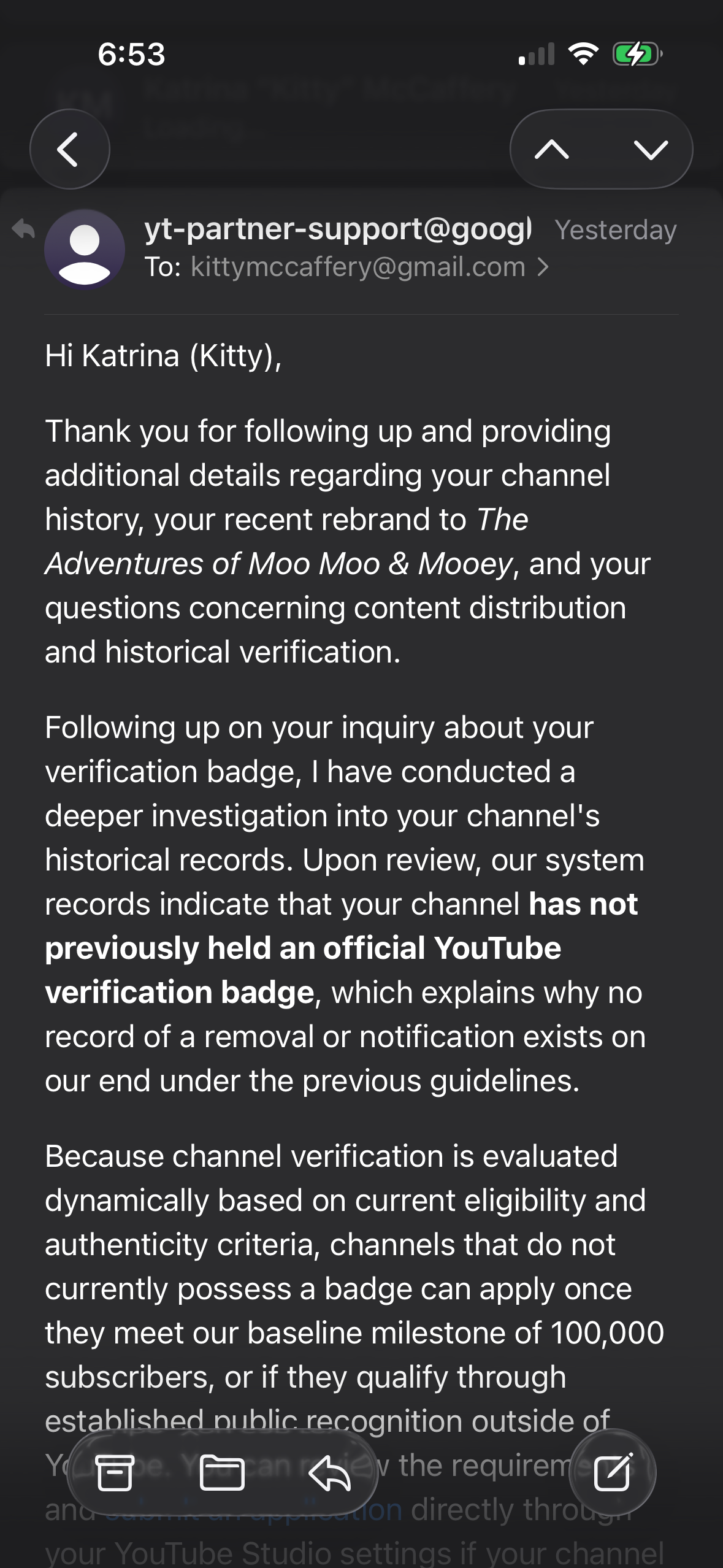
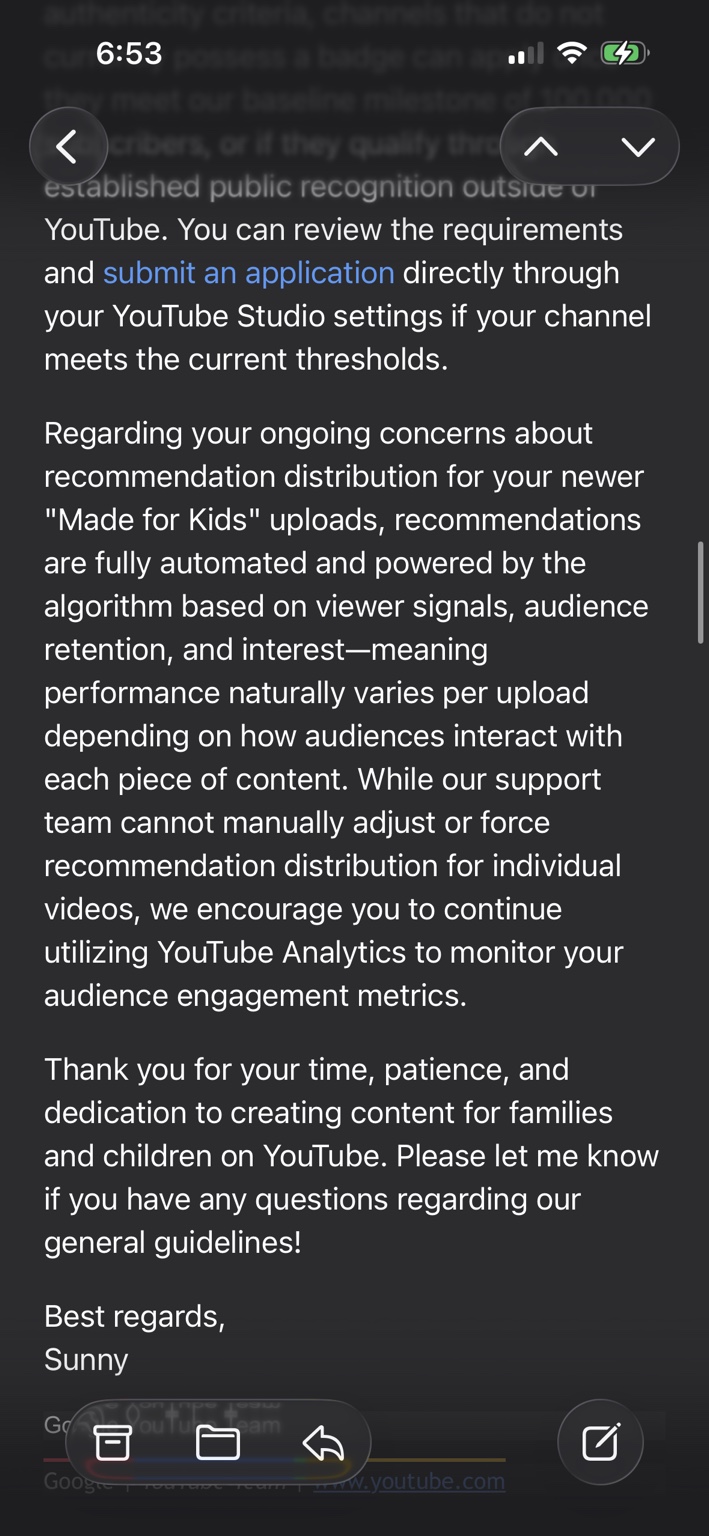
In my first exchange with a representative named Sunny, I asked why the verification badge previously displayed on my long-established channel had disappeared. The response instead explained how channels that have never been verified can apply once they reach 100,000 subscribers, along with general authenticity and completeness requirements.
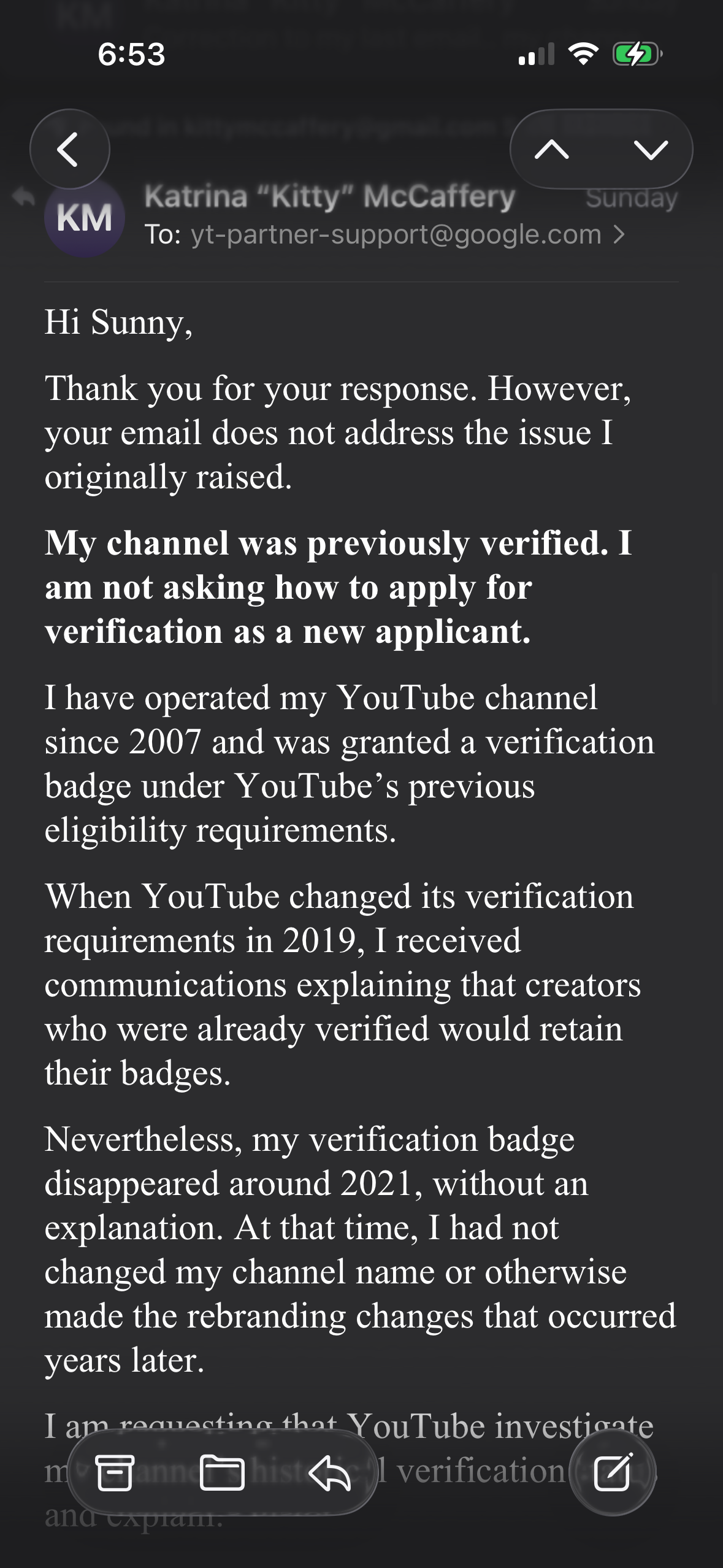
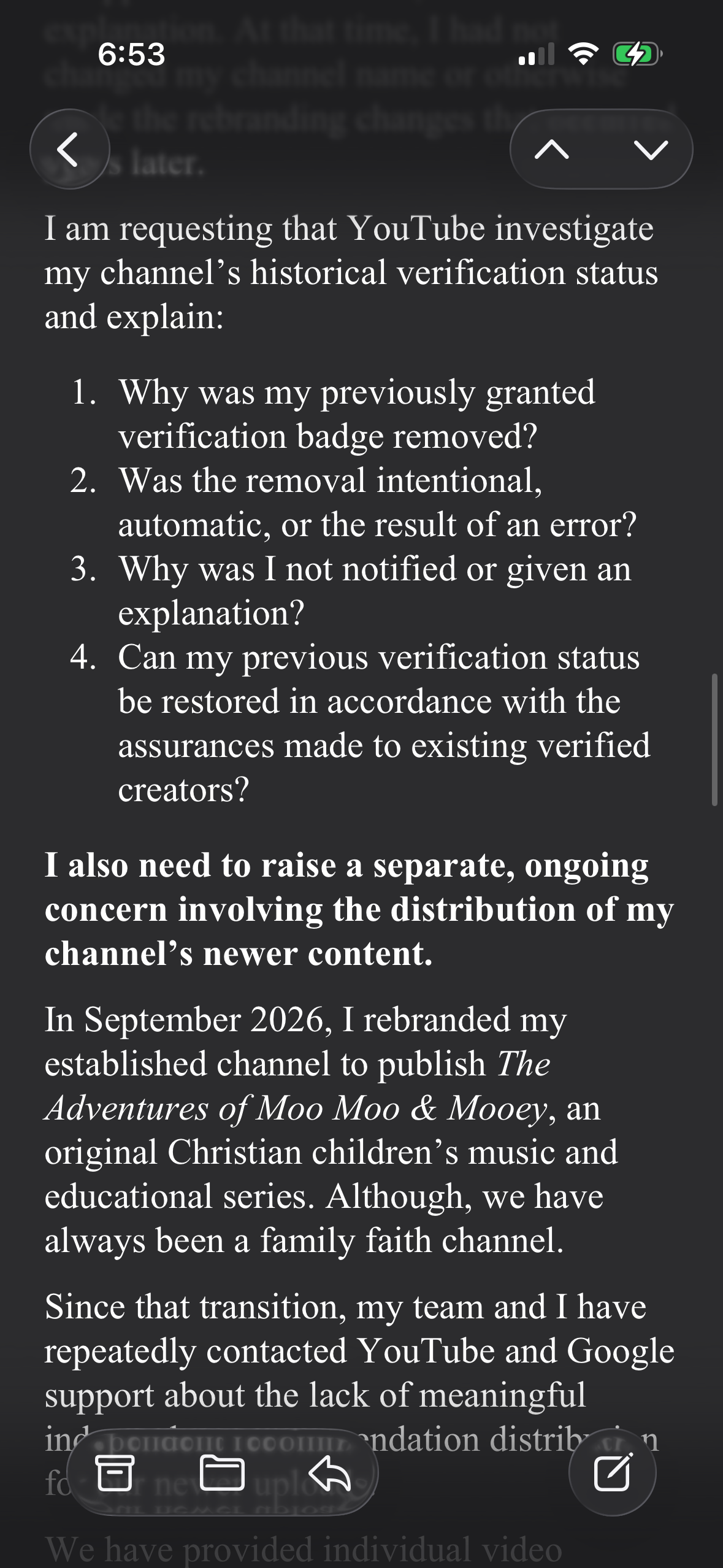
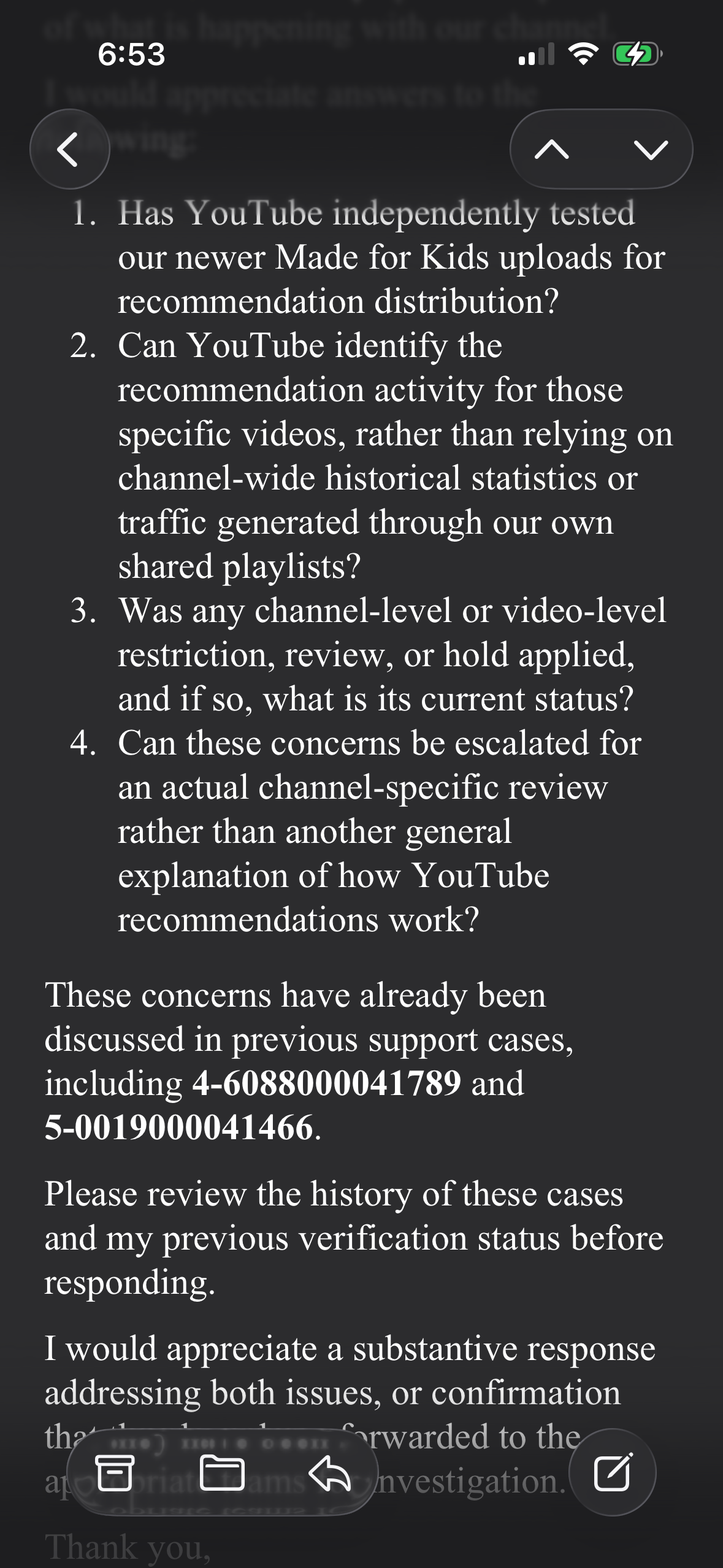
That did not address my question. I was not asking to apply for verification for the first time; I was asking YouTube to investigate a badge my channel had already displayed. I replied with that distinction, asked for a review of historical verification records, and separately reiterated my concerns about the distribution of newer uploads.
October 19: YouTube Says Its Records Show I Was Never Verified
Sunny then wrote that a deeper investigation had been conducted into the channel's historical records and stated:
“Upon review, our system records indicate that your channel has not previously held an official YouTube verification badge.”
The email said this explained why there was no removal or notification record. This was a specific claim about my channel's history—not merely an explanation of current verification policy—and I disputed it.
The same email described recommendations as automated, driven by audience signals and retention, and said support could not manually force distribution. But it did not provide the requested video-specific investigation, address the differing accounts previously relayed to us by Google representatives, or explain the sharp decline affecting my older family videos as well as the new Made for Kids content.
October 19: Archived Channel Pages Contradict the Historical Claim
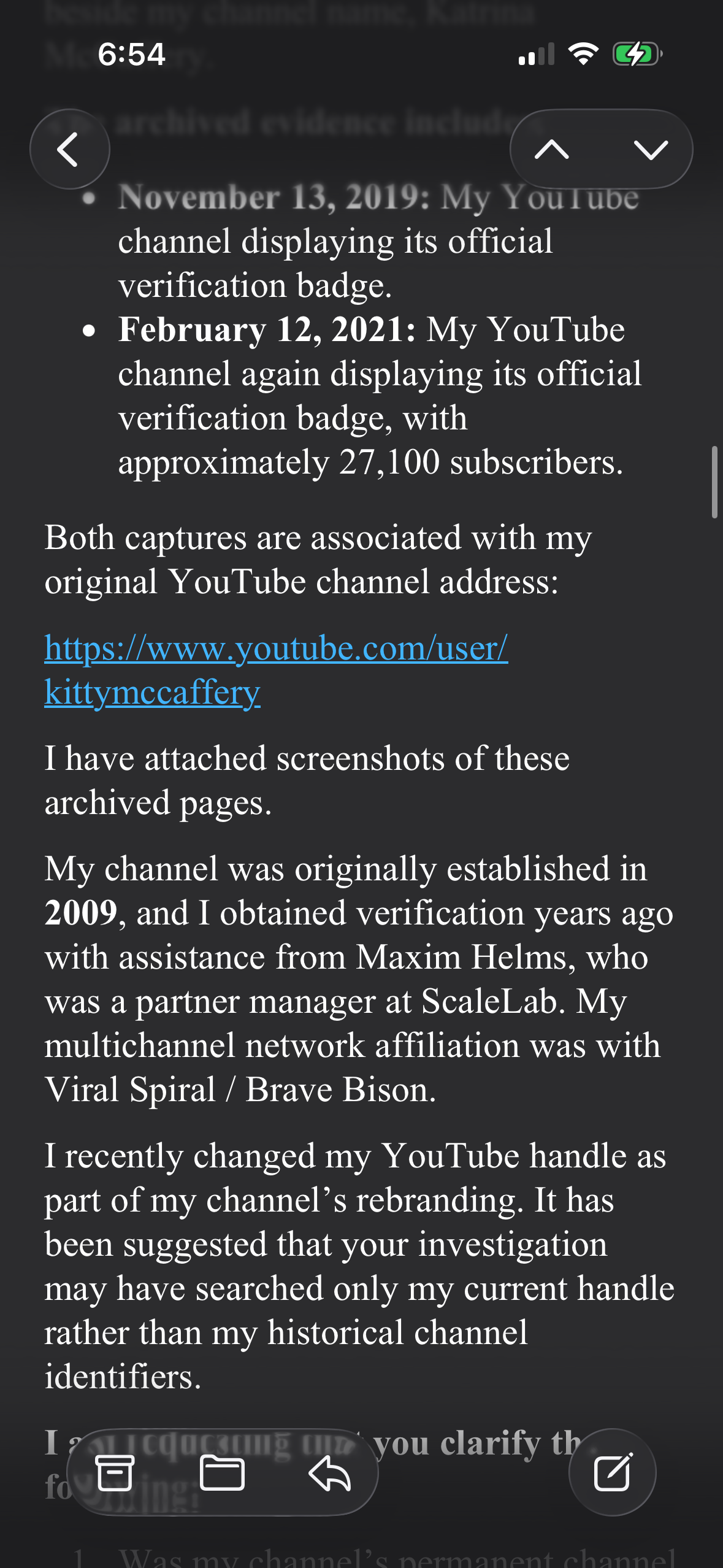
I located archived captures of my original channel through the Internet Archive's Wayback Machine, associated with my former channel URL, youtube.com/user/kittymccaffery. The captures I identified are dated November 13, 2019 and February 12, 2021. They show the verification checkmark beside my channel name. The February 2021 capture shows approximately 27,100 subscribers.
I sent YouTube screenshots of those archived pages and explained that my channel began in 2009. I also described the historical assistance I received from Maxim Helms, then a partner manager at ScaleLab, and my network affiliation with Viral Spiral / Brave Bison.
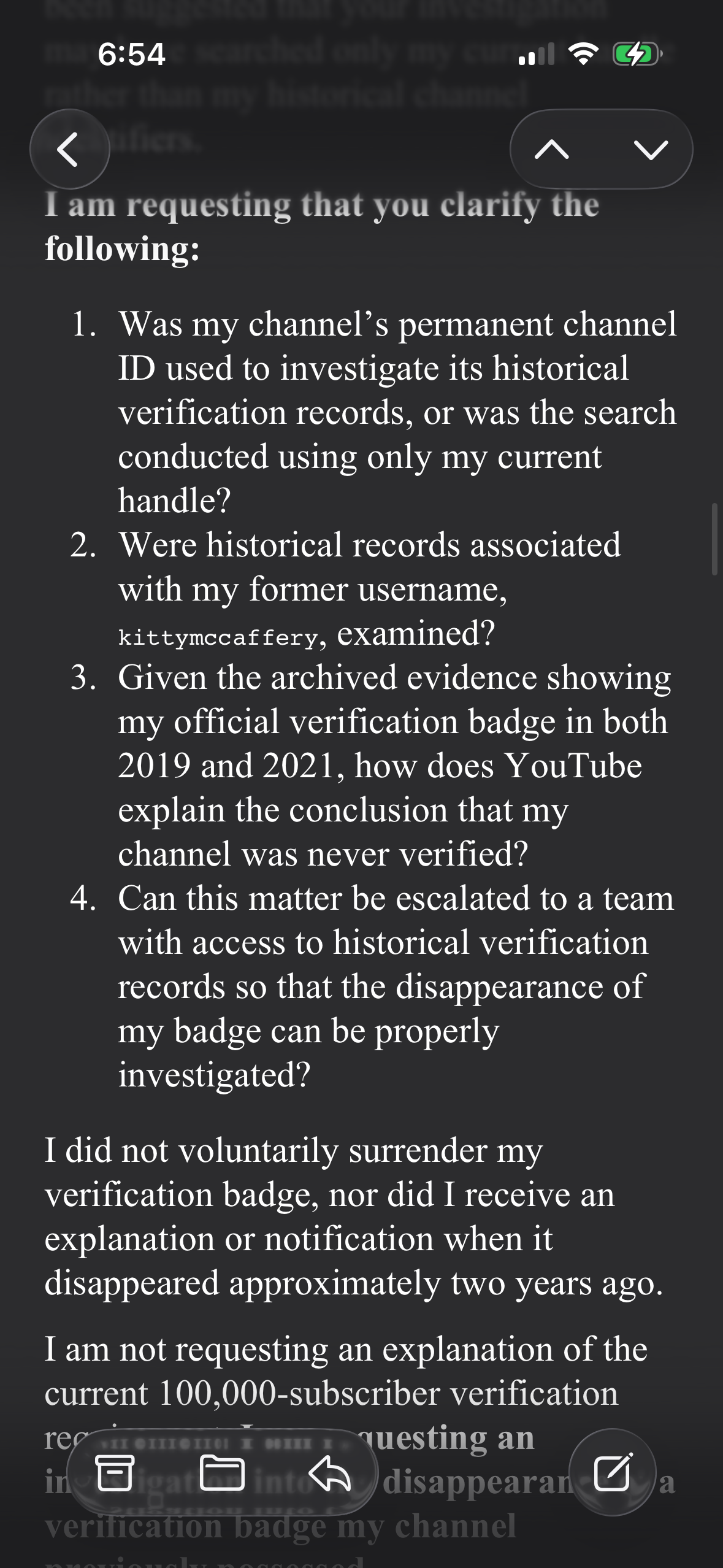
Because I had changed my channel handle during the September 2026 rebrand, I specifically asked whether YouTube had searched the channel's permanent channel ID and former username or only the current handle. I asked how its assertion that I had never been verified could be reconciled with the archived captures and requested escalation to a team with access to historical verification records.
The captures are evidence of what the public-facing channel displayed on those dates. They do not, by themselves, establish the exact date or reason the badge later disappeared. That is precisely what I am asking YouTube to investigate.
October 20: Another General Response, Without Addressing the Evidence
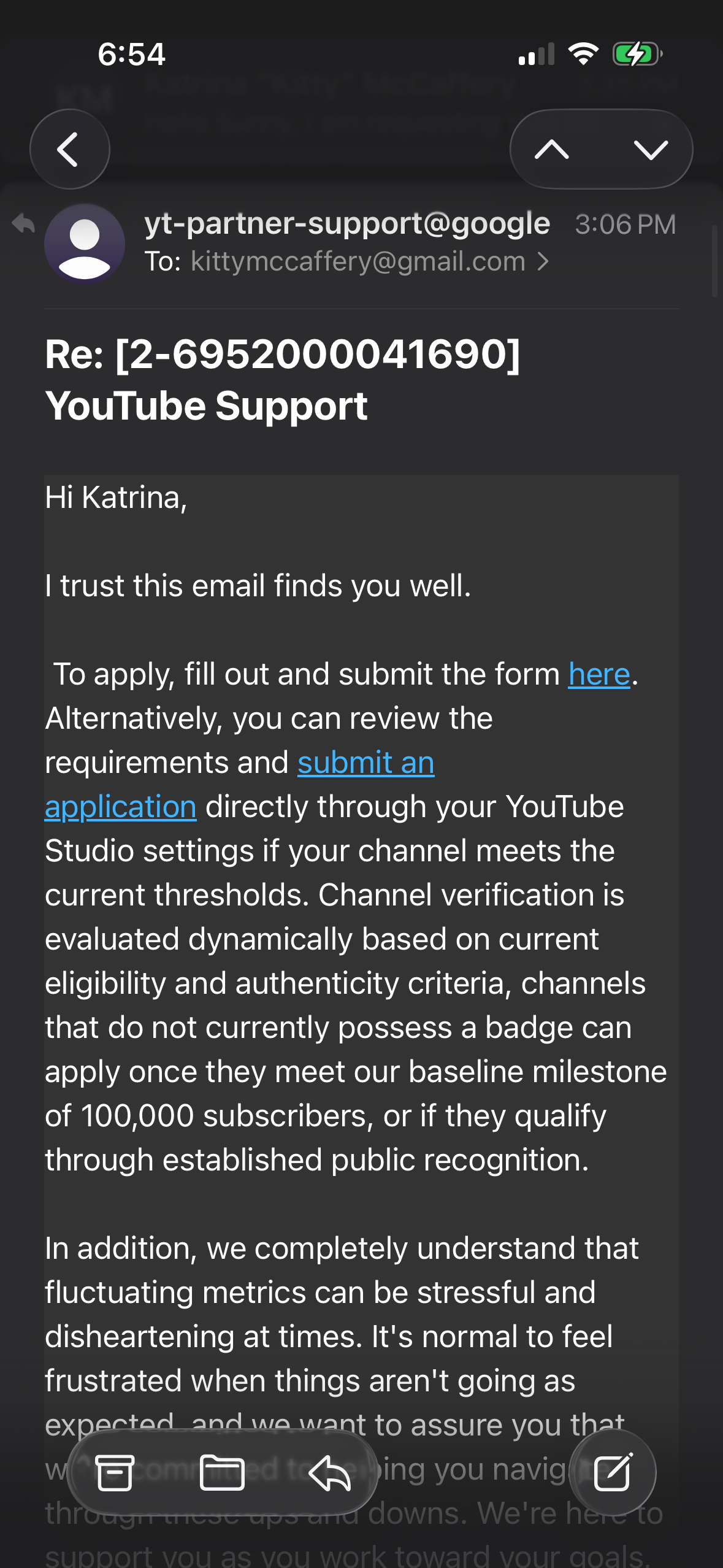
The next response, under support case 2-69520000416901, again explained how to apply for a verification badge under current rules. It did not address the archived 2019 and 2021 captures, confirm which historical channel identifiers had been checked, or explain the earlier conclusion that my channel had never been verified.
The response also said:
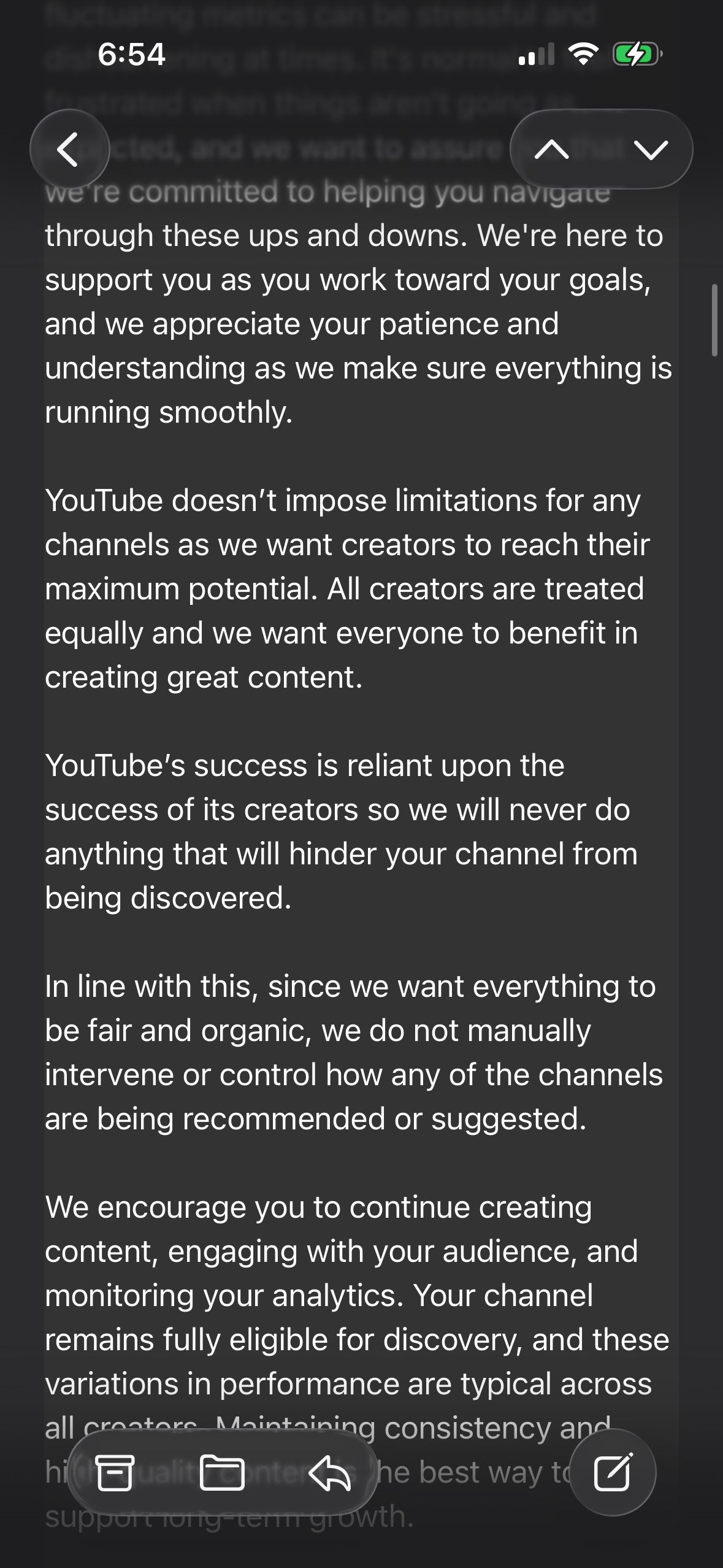
“YouTube doesn’t impose limitations for any channels as we want creators to reach their maximum potential.”
And:
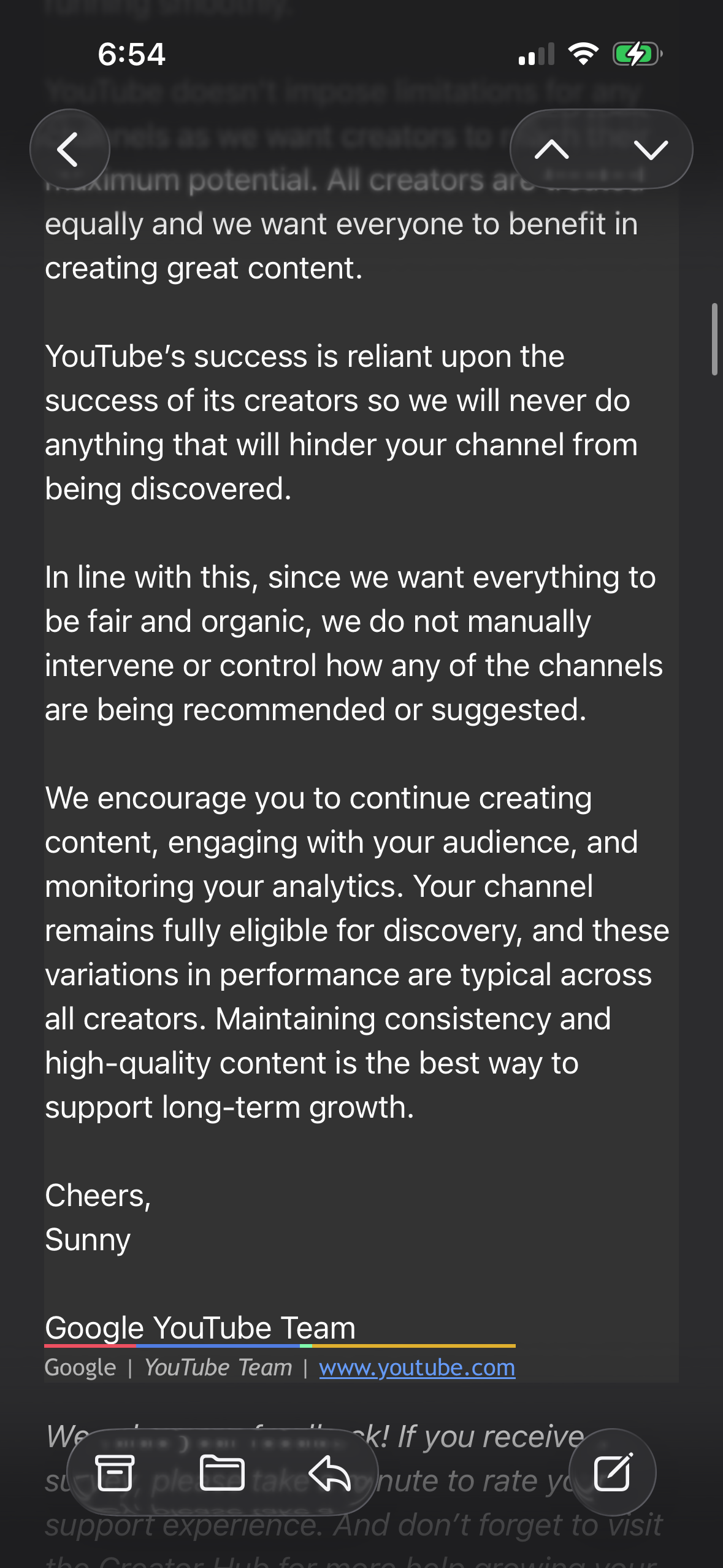
“We do not manually intervene or control how any of the channels are being recommended or suggested.”
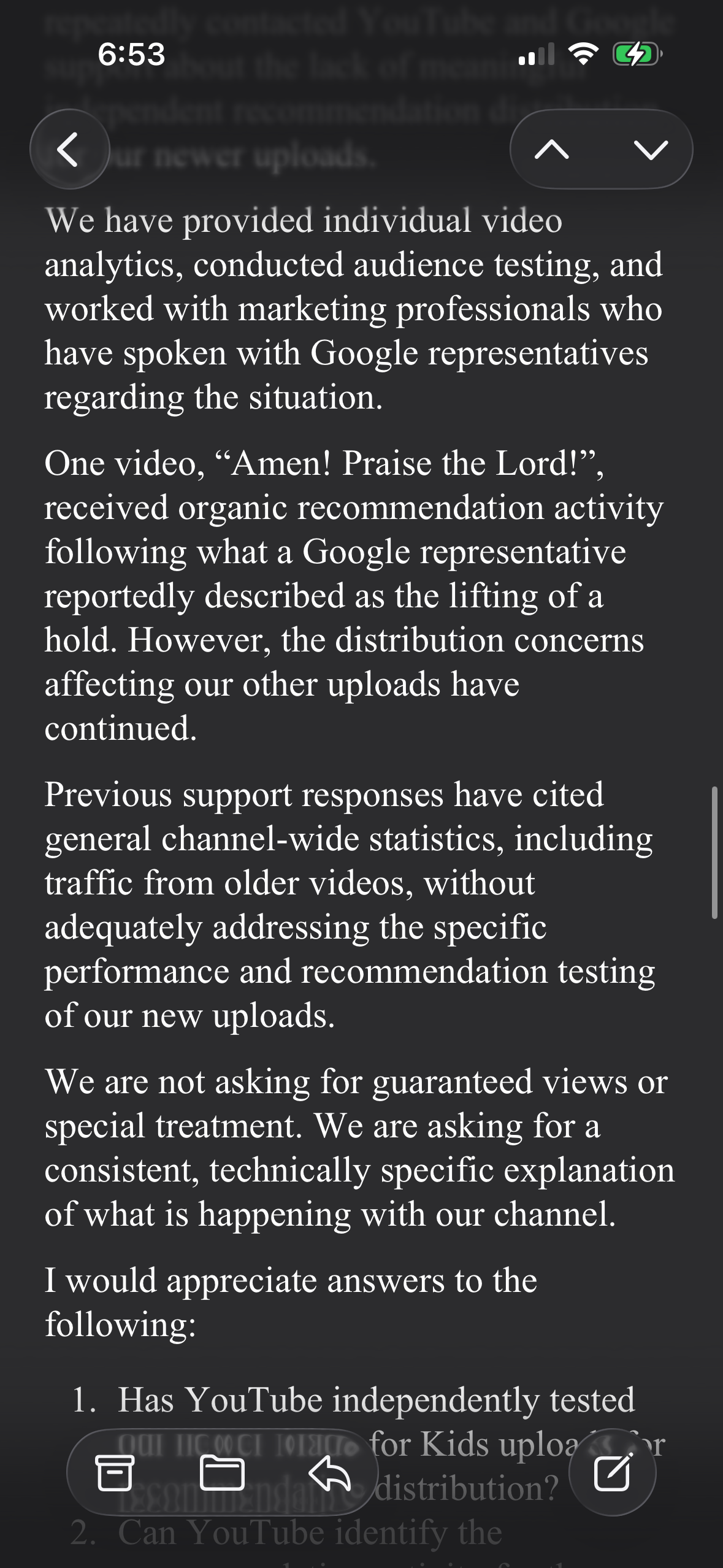
It further stated that my channel remains fully eligible for discovery and characterized the variations as typical. These are YouTube Support's written statements. They do not answer my request for channel-specific findings or reconcile what my team was previously told by other Google representatives about a possible hold and subsequent activity on “Amen! Praise the Lord!”
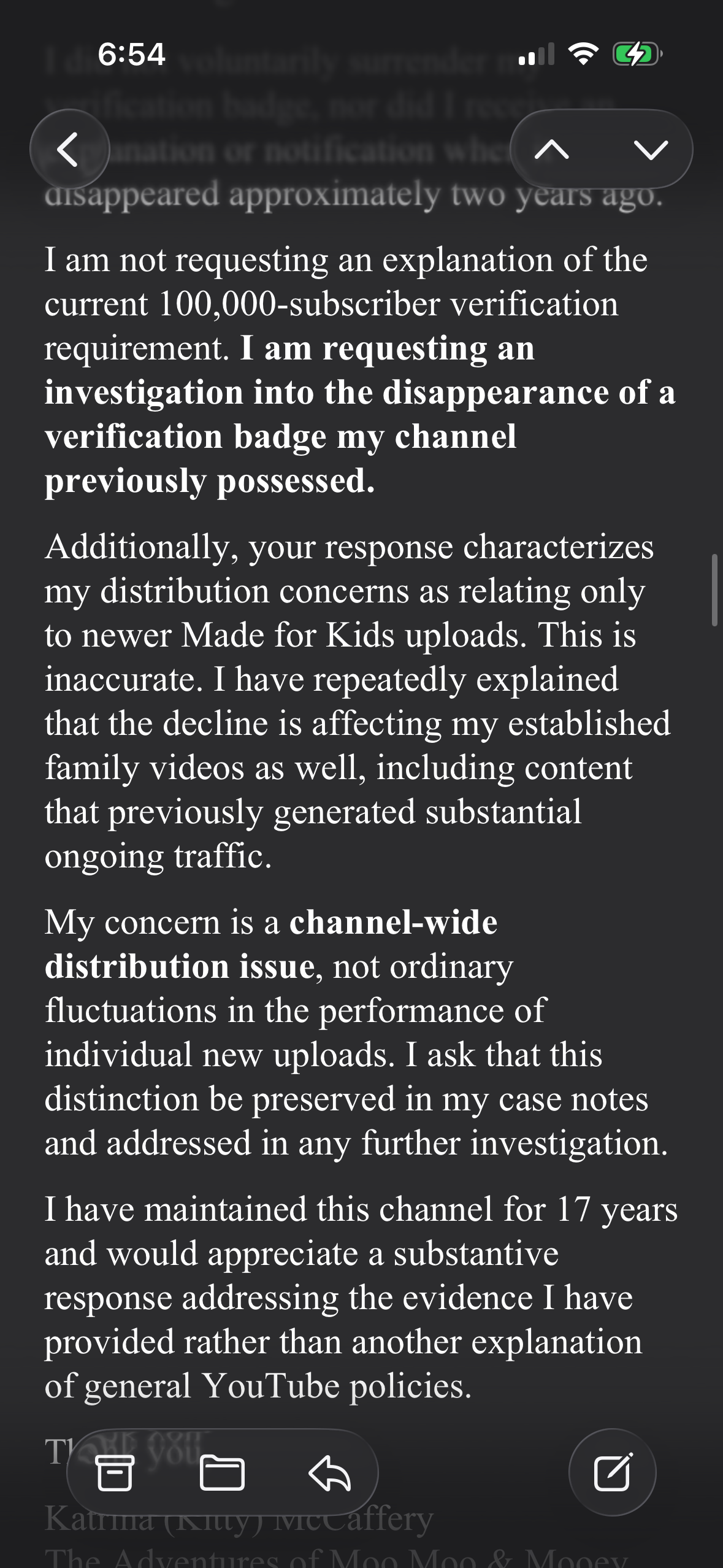
My concern is not limited to how individual new videos perform. The decline I have documented also affects older, established family content that previously generated sustained traffic. I specifically corrected YouTube on this point, because explaining Made for Kids recommendation behavior alone does not account for the wider pattern I have reported.
What Remains Unanswered
- Why did YouTube's historical review conclude that my channel had never been verified when archived versions display a verification checkmark in 2019 and 2021?
- Did the review use my permanent channel ID and original username, or only my newer handle?
- When and why did my badge disappear, and can its previous status be restored?
- What channel- or video-specific checks support the statement that the channel is fully eligible for discovery?
- How does YouTube account for the decline affecting older family videos alongside newer Moo Moo & Mooey uploads?
- How do these written responses reconcile with the different explanations previously relayed to our team by Google representatives?
I have also tagged YouTube publicly on X and Facebook about this open letter without receiving a visible public response. My website statistics have not shown an identifiable visit attributable to YouTube, although those statistics cannot establish whether anyone at the company has viewed the article.
I am still not requesting guaranteed views, preferential treatment, or a manual boost. I am asking YouTube to examine the evidence I provided and respond to the specific questions, rather than repeat general guidance.
Supporting Screenshots: October 2026 Email Correspondence
The screenshots below show the email exchange with YouTube Creator Support and my written responses, including the disputed historical-verification claim, my archived-evidence follow-up, and the latest reply. They are presented in the sequence supplied, with some overlap between screenshots to preserve continuity.
Full YouTube Support Transcripts — For Transparency
For transparency purposes, I have included links to the full transcripts of my conversations with YouTube Creator Support on October 15 and October 16, 2026.
I believe readers should have the opportunity to examine these conversations themselves, including the questions I asked, the explanations provided by YouTube representatives, and the responses I received.
These transcripts are being made available so readers can review the exchanges in their original context and draw their own conclusions.
October 15, 2026 — YouTube Representative Beatrice
Read the Full Support Transcript
Case #4-6088000041789
October 16, 2026 — YouTube Representatives Samantha and Supervisor Ava
Read the Full Support Transcript
Case #5-0019000041466
Sincerely,
Katrina McCaffery
Creator, The Adventures of Moo Moo & Mooey
YouTube: @mooandmooey
Official Website: https://kittymccaffery.com
The Adventures of Moo Moo & Mooey: https://mooandmooey.com